Informaticist Q&A with Leah Welty, PhD
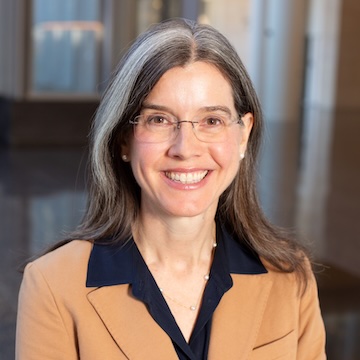
What is your background?
My undergraduate degree is in math, which I really love. I even taught high school math for two years before I went to grad school. During that time, I figured out I wanted to do something more applied and connected to science – math can be pretty theoretical. I got my graduate degree in statistics, but my postdoc was in biostatistics and I knew I had found my home. It’s math based and connected to science, but has a human element.
How did you get into the informatics space?
I wouldn't go so far to call myself an informaticist. I am informatics adjacent, with biostatistics and informatics growing more connected every day. I think a lot about how we gather data and how it’s structured – all of which has implications for analysis.
I became more connected to informatics and people doing informatics at Northwestern when I wanted to develop software. Fortunately, Luke Rasmussen heard me talk about this and was able to create the StatTag software development project. That was 13 years ago, and we've been collaborating ever since then.
Tell us more about your work and the software your team developed.
Reproducibility and robustness are themes of my work. Conducting research in an academic health center means that we’re handling data and conducting analyses with a lot of people involved in big research projects. How do we make sure we're keeping track of the data, using the right versions of the data, doing appropriate statistical analyses, and drawing appropriate conclusions?
StatTag was my first software development project with Luke and a team we put together, including Abigail Baldridge and Eric Whitley. It connects statistical output from R, Stata, SAS and Python to Microsoft Word (no more copy and paste or losing the provenance of results!). More recently, we’ve developed StatWrap – a free, open-source, inventory tool to document the data and analysis side of research projects. It inventories data and code files, and organizes information without additional input from the user, while also allowing users to add searchable and filterable notes connected to files to help communicate metadata about intent and analysis steps.
What challenges related to informatics are you facing?
Everybody wants to do high-quality, rigorous and robust research, but it takes an investment in time, and we are all under pressure to do things quickly. That's a hard balance. How do we make sure we're doing the things that protect us from making mistakes now or in the future, while also maintaining efficiency? For example, if somebody's writing a code file and they're in a hurry, they may not want to comment on it, but you need those comments to ever be able to revise those analyses. When you go back to that project three months or even a year from now, it helps to know what that code was doing.
Is there a project that you would like to highlight?
I’m proud of a lot of different projects. It’s hard to just pick one! I am the director of our Biostatistics Collaboration Center (BCC) with 13 faculty and nine staff. We work on about 300 research projects a year with more than 200 principal investigators across Northwestern and our clinical partners. I am inspired by all the great science we do here at NU, and proud that the BCC plays a role in a good bit of it. Our group brings enthusiasm, sophisticated methods and good thinking to hard questions every day.
Informatics and data science are very collaborative. Who do you collaborate with?
One of my longest-standing collaborations is with the Health Disparities and Public Policy Program; Linda Teplin is the principal investigator. We've been collaborating for more than 20 years as part of the Northwestern Juvenile Project to examine the health needs and outcomes of youth who were in the juvenile justice system. We ask important questions, have amazingly rich data, and do careful, impactful work.
What advice would you give to a student wanting to get into this field?
I would say you need to have quantitative skills and reasoning, but you also need to have communication skills. It's important not to neglect the latter, making sure to focus on both your written and verbal communication.
What are you excited about in the field of informatics right now?
AI. AI. AI. It's an understatement to say AI is going to change the way we work. A big question I have, given my focus on reproducibility and rigorous research, is how to deploy AI in a way that benefits our work but doesn’t hurt the integrity of our studies. I don't think AI is going to replace informaticists or a biostatisticians, but we need to figure out how we can best leverage AI with our expertise.
Written by Eva Winckler