Healthcare Innovation Drives Recipients of 2026 Research Project Awards
What’s standing between patients and faster access to lifesaving healthcare innovations?
That’s the question that new projects supported by the Northwestern University Clinical and Translational Sciences (NUCATS) Institute hope to answer. The 2026 Translational Science Research Project Awards, providing up to $400,000 in funding over two years, seek to find innovative proposals aimed at bridging the gap from bench to bedside.
The 2026 awardees feature two projects: one co-led by Jenny Jia, MD, MS and Andrea Graham, PhD, and the other co-led by George Jesus Greene, PhD, MS and Christine Schaeffer, MD.
Jia and Graham’s research will examine Food is Medicine (FIM) interventions and how to integrate healthy nutrition into healthcare to directly prevent, manage and treat chronic illnesses. The burden of accessing healthy food assistance is often left up to patients, and Jia notes that individual patients’ competing priorities lead to a gap in care: “Substantial amounts of healthy food assistance in these programs go unclaimed,” she says. “It turns out that free is not always enough.”
The new project will study the ongoing Sinai Delivery program, a healthy grocery intervention augmented with direct enrollment, home delivery, automated ordering and more supported by a digital app for safety-net patients in Chicago. “The main goals of our study are to understand what augmentations enable better access to FIM and how the program influences cardiometabolic health – both key knowledge gaps that hinder health payers from adding such programs as benefits to patients,” says Jia. “The findings could improve how we address health-related resources in healthcare, leading to more effective connections with community resources – and consequently, better overall health outcomes.”

The findings could improve how we address health-related resources in healthcare, leading to more effective connections with community resources – and consequently, better overall health outcomes.”
Greene and Schaeffer’s project seeks to improve a common disconnect in which patients discharged from the hospital fail to make it to their first follow-up appointment. Entitled Translating Healthcare Retention Insights across Varied Environments (THRIVE), their study will use Northwestern Medicine’s Translational Care Clinic as a real-world setting to understand where – and why – patients are lost between discharge and follow-up, while developing pragmatic ways to keep them connected.
“This is a fundamental translational science challenge, and one that disproportionately affects patients facing barriers such as lack of health insurance or transportation,” say Greene and Schaeffer. "This study will combine health system data with what we learn directly from patients and care teams, including our community health center partners, to develop practical tools that fit within existing clinical workflows."
This is a fundamental translational science challenge, and one that disproportionately affects patients facing barriers such as lack of health insurance or transportation.”
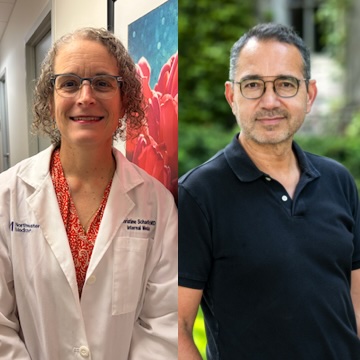
While the projects vary in scope, funding from these awards shares a common thread of improving the focus and capabilities of existing programs. “For almost a year, this collaboration has been trying to unlock ways to study the Sinai Delivery Program – in a resource-limited context, this award allows us to leverage an innovative, existing program to solve key knowledge gaps,” says Jia.
“Building the Northwestern Medicine Translational Care Clinic has been my main clinical and research project for the last fifteen years – but one of our biggest ongoing frustrations has been getting patients to come to their initial follow-up appointments,” says Schaeffer. “We are excited to combine clinical experiences with data analysis, assessment and implementation science to address these gaps in care engagement.”
The 2026 Translational Science Research Project Awards were informed by the results of the Healthcare Innovation Challenge, in which the NUCATS Institute crowdsourced ideas from across Northwestern. Ideas that shaped Request for Proposal (RFP) came from researchers, students, staff and clinicians, helping to ensure that the research projects were informed by the broader translational science community.
The NUCATS Translational Science Research Project Awards, offered every two years, support innovative, multidisciplinary proposals that reimagine how care is designed, offered, accessed, communicated, delivered and evaluated for impact. They focus on reach, scalability and real-world feasibility, supporting interventions that address gaps in how evidence-based care is identified, communicated, linked and sustained in practice. Research reported in this publication was supported, in part, by the National Institutes of Health's National Center for Advancing Translational Sciences, Grant Number UM1TR005121. The content is solely the responsibility of the authors and does not necessarily represent the official views of the National Institutes of Health.
Written by Kevin Castro