A novel, team-focused approach is bringing together faculty from across Northwestern to identify previously unexplored collaboration opportunities.
Hosted in February 2026 by the Northwestern University Clinical and Translational Sciences (NUCATS) Institute and the Northwestern Institute on Complex Systems (NICO), the Symposium to Empower High-Priority Research Collaborations focused on addressing critical challenges in human health and disease through team-based approaches. Bringing together nearly 40 faculty participants, attendees represented 29 departments, divisions or units across four Northwestern schools and two clinical affiliates.
The creative ideas that came out of it showcase the potential payoff when we overcome the barriers separating people.”
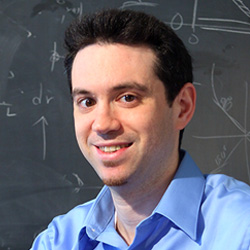
"A big part of our mission at NICO is to catalyze interdisciplinary collaborations across the university,” says Daniel Abrams, PhD, Co-Director of NICO. “Together, we managed to convince some very busy senior faculty from across Northwestern to dedicate a day to exploring new interdisciplinary research directions. The creative ideas that came out of it showcase the potential payoff when we overcome the barriers separating people."
After making connections through networking and facilitated collaboration sessions, attendees concluded the event with a team-based competition in which researchers had the opportunity to apply for up to $50,000 in seed funding to advance their projects toward external grant applications.
The winning proposal, “Impact of Evolving Environmental Soundscape on Noise, Stress, Communication and Sleep,” was submitted by Rosemary Braun, PhD (Associate Professor in the Department of Molecular Biosciences within the Weinberg College of Arts & Sciences), Bharath Chandrasekaran, PhD, MS (Professor in the Department of Communication Sciences within the School of Communication), Jennifer Dunn, PhD, MSE (Professor of Chemical and Biological Engineering within the McCormick School of Engineering), and Judith Moskowitz, PhD, MPH (Professor of Medical Social Sciences within the Feinberg School of Medicine and Weinberg)—all of whom have not collaborated with each other in the past. “It was such a treat to spend the day brainstorming with colleagues I would not normally get to work with,” says Moskowitz. “The best part was talking with people from completely different fields and wrestling with the question of what kind of grant we might write together, given how different our expertise is.”
Their proposal will explore how quickly-expanding data centers—and the noise they generate—are affecting urban, suburban, and rural communities in the United States. “This noise exposure disrupts communication, increases stress and anxiety, interferes with sleep and directly impacts cognition, among other ill effects,” the team says. “With hundreds of data centers in the pipeline, the understudied nature of these impacts poses a risk for societal well-being in the U.S.”
The researchers hope that insights from their study will guide health providers and policymakers in developing effective interventions, while also informing the data center industry about the health effects of their facilities. “Rather than focusing on what we were already doing, we dove right in to talk about what we could do together,” says Braun. “It suddenly became clear that each of us had a unique angle to contribute. I’d never have imagined my research taking this turn.”
The enthusiasm for the proposal was contagious, says Chandesakran. “Within this group, there was immediate mutual respect, genuine excitement, and a can-do, ‘let’s boldly venture into edge science’ attitude that was truly infectious.”
Even when there was no immediate collaboration opportunity, it was phenomenal to learn so much more about Northwestern research.”

In a post-event survey, 93% of respondents indicated they made meaningful connections with other attendees and 76% left the conference with new insights into the types of cross-disciplinary collaboration that could advance their research. “For me, even when there was no immediate collaboration opportunity, it was phenomenal to learn so much more about Northwestern research,” says Dunn.
The positive reception has the NUCATS and NICO teams hopeful for the potential of future collaborations.
“Working with NICO’s road-tested innovations in scientific team assembly has really added a lot to NUCATS’ efforts," says Richard D’Aquila, MD, NUCATS multiple principal investigator (MPI). “I am thrilled that this event was so successful, and I look forward to more collaborations with NICO’s ‘science of team science’ experts.”
Written by Kevin Castro